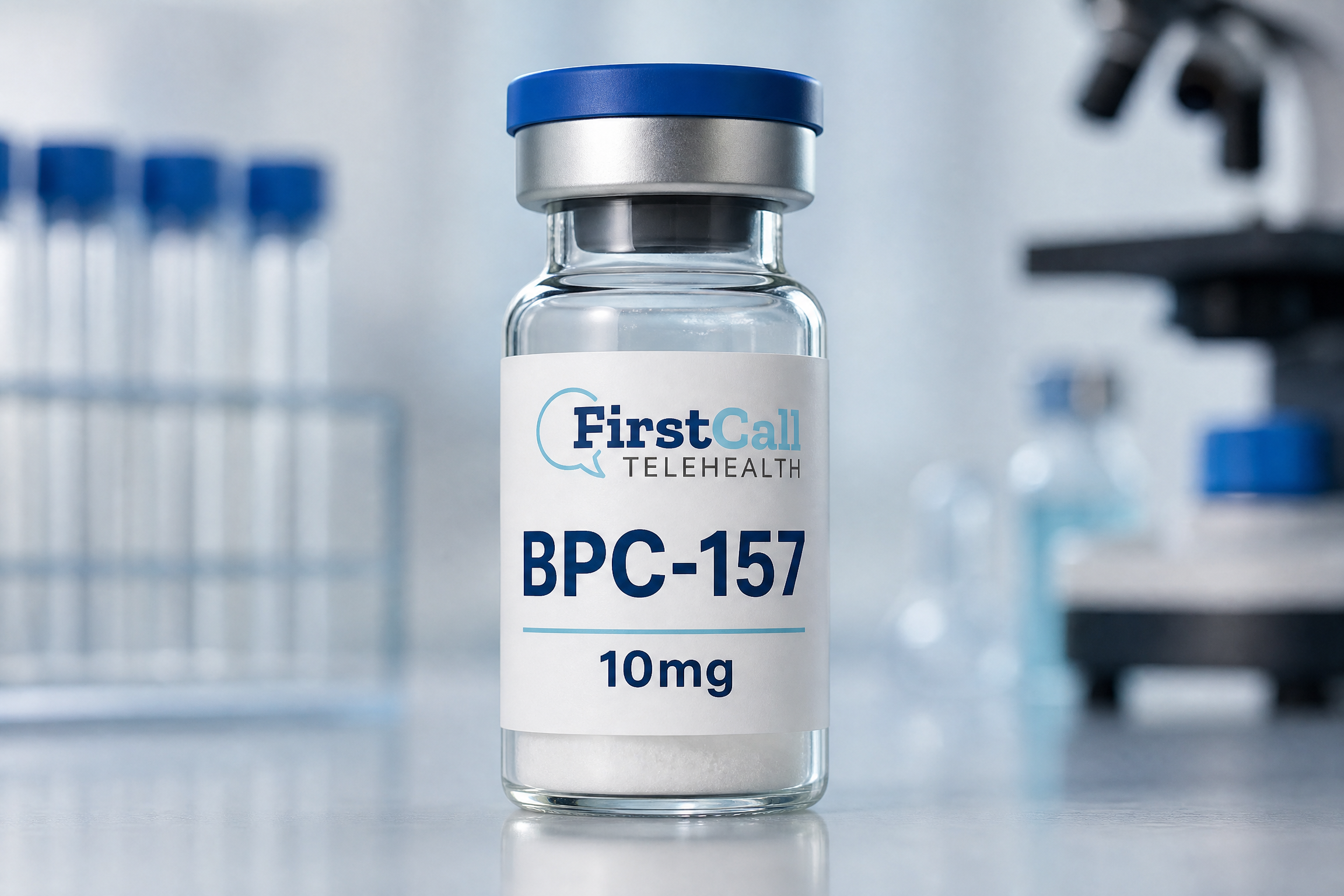
BPC-157
Body Protection Compound-157 — studied for tissue repair, gut health, and recovery.
BPC-157 is a synthetic 15–amino-acid peptide derived from a protective protein found in gastric juice. It’s one of the most-researched recovery peptides, studied for its role in healing soft tissue, tendons, ligaments, and the gut lining.
Prescription required. Final clinical decisions rest with the prescribing physician.
What is BPC-157?
BPC-157 (Body Protection Compound-157) is a stable synthetic peptide fragment derived from a protein found naturally in the stomach. In research settings it has been studied as a signaling and cytoprotective molecule — one that appears to support the body’s own repair processes rather than acting like a steroid or hormone.
Pre-clinical research has explored its role in angiogenesis (forming new blood vessels), modulation of growth factors, and the healing of muscle, tendon, ligament, and gastrointestinal tissue. Many people use it during recovery from soft-tissue injuries or to support gut health, under physician supervision.
BPC-157 is not FDA-approved as a finished drug product. It is accessed through licensed compounding pharmacies for off-label use under a physician’s prescription. FDA rules around peptide compounding continue to evolve — the physician you’re connected with will confirm current availability.
Potential benefits
Soft-tissue & muscle recovery
Studied for supporting repair of strained or overworked muscle tissue during recovery.
Tendon & ligament repair
Research interest centers on connective-tissue healing — tendons and ligaments that are typically slow to recover.
Gut health & GI lining
Originally derived from a gastric protein; studied for its protective effect on the stomach and intestinal lining.
Inflammation modulation
Examined for its role in calming the local inflammatory response that follows injury.
Joint & mobility support
Often used in recovery protocols aimed at joint comfort and range of motion.
Often paired with TB-500
Frequently combined with TB-500 in recovery stacks — your physician will advise if a blend is appropriate.
How it works
How it’s taken
Most often a small subcutaneous injection using an insulin-style syringe; an oral capsule form is also available. The route, dose, and cycle length are set by the prescribing physician based on your goals and history.
Typical protocol
Recovery protocols commonly run in 4–8 week cycles. Some patients dose near the area of concern; others dose systemically. Your physician will give specific instructions with your prescription.
How ordering works
Complete the intake
Share your goals, health history, and current medications — about 5 minutes.
Physician evaluation
An independent, board-certified physician reviews your intake and, if appropriate, prescribes BPC-157 with a dosing protocol.
Compounded & shipped
The prescription is filled by a licensed compounding pharmacy and shipped to your door with instructions.
What to know before BPC-157
BPC-157 is a bioactive compound. The physician you’re connected with will review the relevant risks and contraindications for your situation before prescribing.
- •Injection-site reactions (mild redness or swelling) are the most commonly reported side effect.
- •Long-term human safety data is limited — most evidence is pre-clinical. This is part of why physician supervision matters.
- •Disclose your full medical history and current medications; a history of cancer or active malignancy should be discussed before starting.
- •Pregnancy and breastfeeding are contraindications.
- •Source matters: gray-market “research only” peptides skip physician oversight and quality testing. FirstCall connects you with a licensed physician and a compounding pharmacy that follows USP standards.
BPC-157 FAQ
What is BPC-157 used for?
BPC-157 is studied primarily for tissue repair — soft-tissue, tendon, and ligament recovery — and for gut health. It’s used off-label under physician supervision; it is not FDA-approved for any specific indication.
Is BPC-157 FDA-approved?
No. BPC-157 is not an FDA-approved finished drug product. It is prepared by licensed compounding pharmacies and prescribed off-label by a physician. FDA guidance on peptide compounding is evolving, and availability can change.
How is BPC-157 taken — injection or oral?
Both forms exist. Most protocols use a small subcutaneous injection, but an oral capsule is also available. The physician you’re connected with recommends the route based on your goals.
How long until I notice results?
It varies by individual and goal. Recovery protocols typically run several weeks; your physician will set expectations and a cycle length for your situation.
Is BPC-157 safe?
When prescribed by a licensed physician and sourced from a licensed compounding pharmacy, short-term use is generally well tolerated. Long-term human data is limited — discuss your history with the physician.
How much does it cost?
BPC-157 starts from $159/month. Final pricing is confirmed by the compounding pharmacy after your physician evaluation, since dose and protocol vary. The initial evaluation is free.
Ready to start BPC-157?
Complete a short medical intake — a supervising physician reviews it and, if appropriate, writes your prescription, and a licensed pharmacy ships to your door.
Pricing & regulatory note: The $159/mo price is an indicative starting point confirmed by the compounding pharmacy after physician evaluation. BPC-157 is not an FDA-approved finished drug product; it is prepared by licensed compounding pharmacies and prescribed off-label. FDA guidance on peptide compounding continues to evolve and availability can change. A prescription is required.