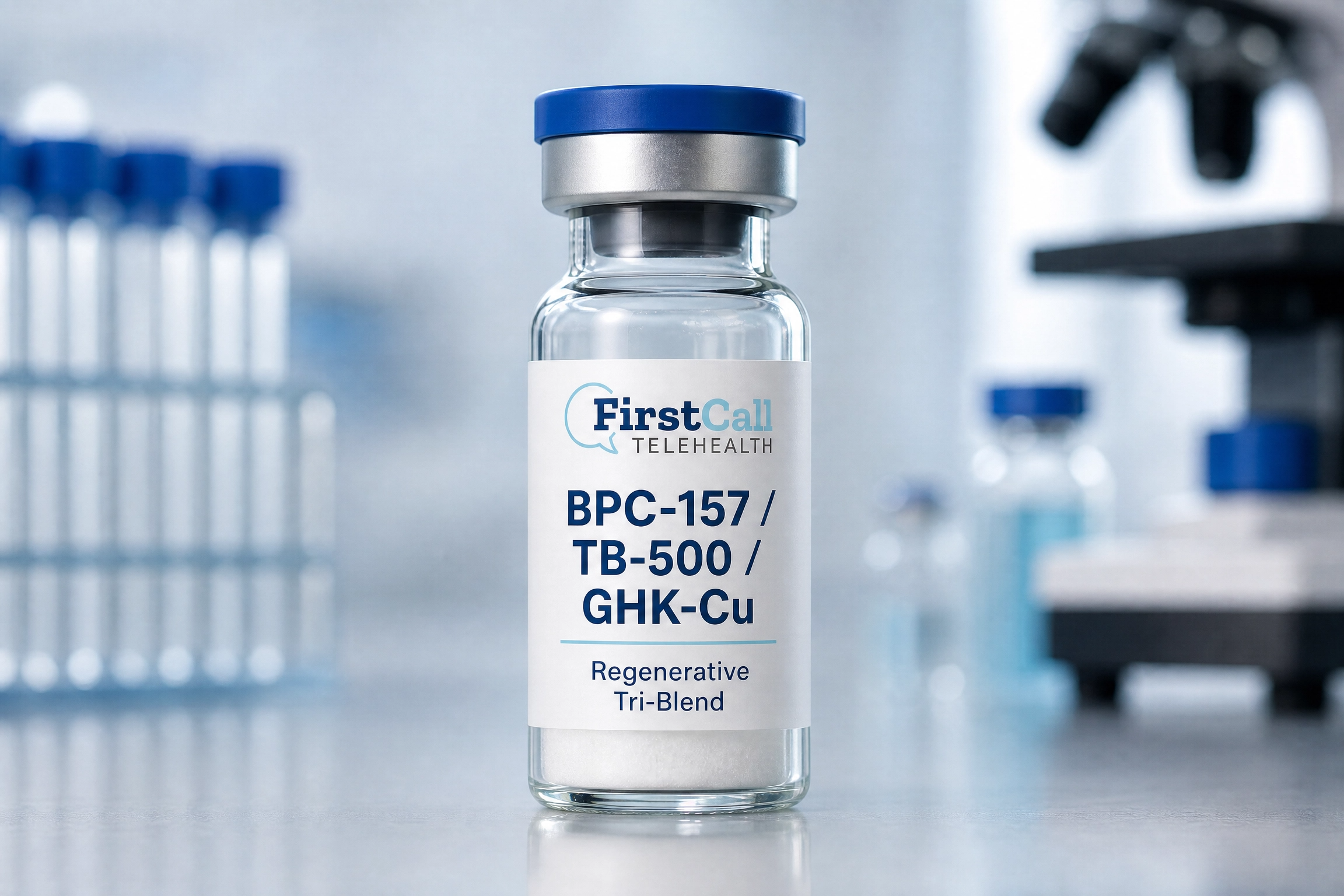
BPC-157 / TB-500 / GHK-Cu
A regenerative tri-blend — BPC-157, TB-500, and the copper peptide GHK-Cu in one vial.
This tri-blend adds GHK-Cu — a copper-binding peptide studied for skin and tissue remodeling — to the BPC-157 / TB-500 recovery pairing, for a broader regenerative protocol.
Prescription required. Final clinical decisions rest with the prescribing physician.
What is BPC-157 / TB-500 / GHK-Cu?
The tri-blend combines BPC-157 (localized repair, gut), TB-500 (soft-tissue recovery), and GHK-Cu (a copper peptide studied for collagen, skin, and tissue remodeling). Together they target recovery and regeneration from several angles in a single formulation.
Strengths are set by the compounding pharmacy. The blend is accessed under a physician’s prescription; it is not an FDA-approved finished product, and FDA guidance on peptide compounding continues to evolve.
Potential benefits
Three-way regeneration
Repair, soft-tissue recovery, and tissue remodeling in one vial.
Adds GHK-Cu
A copper peptide studied for collagen synthesis and skin/tissue quality.
Convenient single injection
All three peptides combined, one dose.
Recovery & tissue quality
A broader regenerative protocol than a two-peptide stack.
How it works
How it’s taken
A single subcutaneous injection of the combined formulation, on a cycle set by the prescribing physician.
Typical protocol
Run in cycles with periodic reassessment; the physician sets the ratios, dose, and duration.
How ordering works
Complete the intake
Share your goals, health history, and current medications — about 5 minutes.
Physician evaluation
An independent, board-certified physician reviews your intake and, if appropriate, prescribes BPC-157 / TB-500 / GHK-Cu with a dosing protocol.
Compounded & shipped
The prescription is filled by a licensed compounding pharmacy and shipped to your door with instructions.
What to know before BPC-157 / TB-500 / GHK-Cu
BPC-157 / TB-500 / GHK-Cu is a bioactive compound. The physician you’re connected with will review the relevant risks and contraindications for your situation before prescribing.
- •Injection-site reactions are the most common side effect.
- •Long-term human safety data is limited for these peptides.
- •Disclose your full history; a history of cancer should be discussed before starting.
- •Source matters: gray-market “research only” peptides skip physician oversight and quality testing. FirstCall connects you with a licensed physician and a compounding pharmacy that follows USP standards.
BPC-157 / TB-500 / GHK-Cu FAQ
What does the tri-blend add over BPC-157 / TB-500?
It adds GHK-Cu, a copper peptide studied for collagen and tissue remodeling, broadening the regenerative profile of the recovery stack.
Is it FDA-approved?
No. It is prepared by licensed compounding pharmacies and prescribed off-label; FDA guidance on peptide compounding is evolving.
How is it taken?
One subcutaneous injection of the combined vial; the physician sets your dose and cycle.
Who is it for?
Patients wanting a broader recovery + tissue-quality protocol. The physician you’re connected with will confirm whether it’s appropriate.
How much does it cost?
The tri-blend starts from $299/month. Final pricing is confirmed after your physician evaluation. The initial evaluation is free.
Ready to start BPC-157 / TB-500 / GHK-Cu?
Complete a short medical intake — a supervising physician reviews it and, if appropriate, writes your prescription, and a licensed pharmacy ships to your door.
Pricing & regulatory note: The $299/mo price is an indicative starting point confirmed by the compounding pharmacy after physician evaluation. BPC-157 / TB-500 / GHK-Cu is not an FDA-approved finished drug product; it is prepared by licensed compounding pharmacies and prescribed off-label. FDA guidance on peptide compounding continues to evolve and availability can change. A prescription is required.